
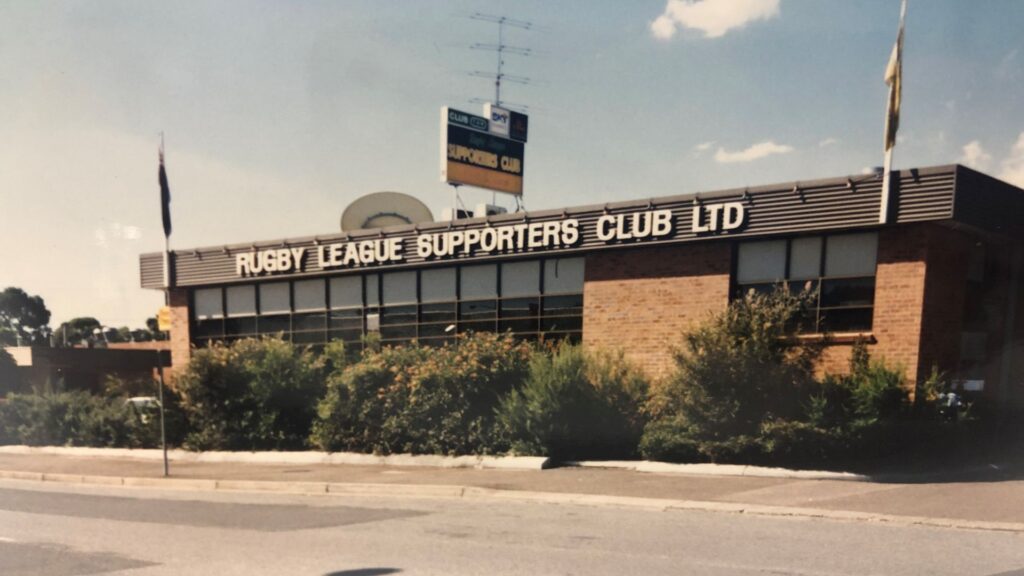
Cessnock Leagues Club in its early days (c. mid-1980s).
Cessnock Leagues Club
Cessnock Rugby League Supporters’ Club was formed at a public meeting at the Cessnock Hotel in October 1972.
For a decade or so prior to this, it had become apparent that clubs with the backing of licensed premises had gained an advantage in the Newcastle Rugby League competition.
An organisation known as Cessnock Leagues Club operated a bowling club in a relocated picture theatre on the former Aberdare Extended paddock (off West Avenue) in the 1960s and ‘70s, but it was unable to secure a liquor licence during this time.
After the Goannas’ success in the 1972 premiership, there were concerns in the community that the club would not be able to retain the strong base of local juniors that emerged that season, with fears these players would be poached by wealthier clubs that were supported by licensed premises.
A conversation between local businessmen and lifelong friends, John Knipe and Boy Bradstreet, at the end of the 1972 season sparked the idea for the public meeting at the Cessnock Hotel. At the meeting it was agreed that a supporters’ club be formed to help where it was needed “for the good of the football club”, including financial assistance, accommodation and jobs for players. A steering committee comprised Knipe, Bradstreet, Keith Allen and Tom Evans.
The football club welcomed the new body and invited Knipe and Bradstreet onto their committee.
It did not take long for the city learn about the supporters’ club and the support was more than gratifying. Numerous fundraising events were held, including a rodeo at Cessnock Showground, dances at Millfield Ex-Services Club, and a 1000 can club (with the organisers unaware that giving away liquor prizes was illegal).
The supporters’ club held several events at Cessnock Town Hall, where volunteers set up and ran a bar out of the cloak room. In May 1976 the club was eventually granted a Limited Public Hall Licence to supply liquor at the functions held in the town hall, which was seen as a big step forward.

Cessnock Rugby League Supporters Club executives John Knipe, Boy Bradstreet and Ray Nickerson toast the success when the club was granted a licence to serve liquor at Cessnock Town Hall in 1976. Picture: The Advertiser
A mass exodus of six first grade players that year highlighted the importance of seriously considering a leagues club as a means for survival, as recalled by then-football club secretary Phil Baird in his 2011 book The Goanna Legend. Baird invited Glen Maloney, the secretary-manager of the very successful Western Suburbs Leagues Club, and Wests’ financial adviser, the prominent Newcastle solicitor Bruce O’Sullivan, to Cessnock to inspect an area of land opposite Cessnock Sportsground that was occupied by Turner’s sawmill. Maloney and O’Sullivan were impressed by the proximity of the site to the sportsground and suggested that moves be made to secure the land for a future leagues club building.
Following the 1977 grand final win under Henry Tatana, there was pressure for the supporters’ club to apply for a liquor licence and start its own licensed premises. The premiership victory certainly pointed out the need to be able to finance future Goannas, otherwise the club would be merely developing junior footballers to be poached by other richer clubs.
Cessnock Rugby League Supporters Club was incorporated as a public company on March 23, 1978. Its inaugural board of directors included: President, John Knipe; Vice-Presidents, Boy Bradstreet, Max Proctor and Bernard Gilmore; and Committeemen, Bill Mitchell, Ray Nickerson and John Wilson.
Failed attempts to gain a liquor licence made for disappointment until a Court of Appeal decision held at Phillip Street, Sydney saw the license granted in April 1979. John Knipe and Boy Bradstreet crossed the street from the court to NSW Leagues Club for a celebratory drink, where they discovered the Leagues Clubs Association of NSW was having a meeting the following night. Realising that they might need financial help from other clubs, they secured a 5-minute address with the Association and as a result, 15 leagues clubs – including St George – provided bank guarantees of $10,000 each.
It was estimated $1,000,000 would be needed to get the project off the ground and a bank loan of $300,000 was made. The sale of debentures to members also helped build the funds.
Now that the goal of securing a licence had been achieved, it was a case of building the long-awaited leagues club as soon as possible. A development application was lodged with council and tenders were called for, with local builder C. C. Turnbull and Sons Pty Ltd landing the task of turning a dream into reality. Construction started in January 1980, and Cessnock Rugby League Supporters Club opened for trade on October 10 that year. The cost of the building was reported to be $850,000.
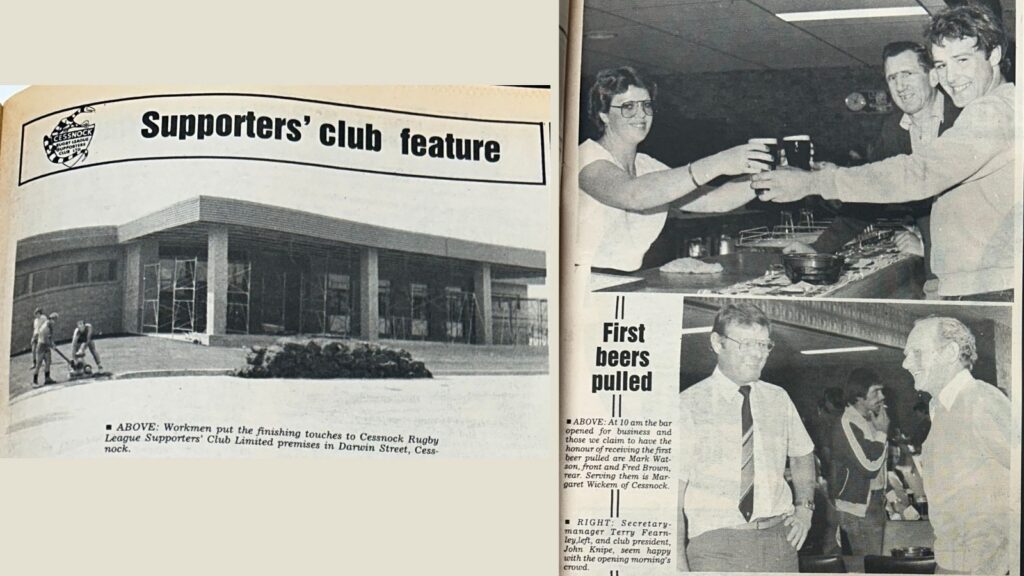
Left, an image from the Supporters Club opening feature (The Advertiser, October 8, 1980). Right, pictures from the first day of trade.
After a few weeks to make sure everything was working efficiently, the official opening was conducted by Australian Rugby League president Kevin Humphreys on November 8. The opening night included entertainment by Jay Justin, Lucky Grills and Debbie Le Rae. It was a great celebration and proud moment for the scores of “local heroes” who worked tirelessly to achieve the dream to ensure the sport of rugby league in the Cessnock area not only survived but achieved enormous goals.
“Your club has been built, here it is, enjoy it,” club president John Knipe said on the opening night.
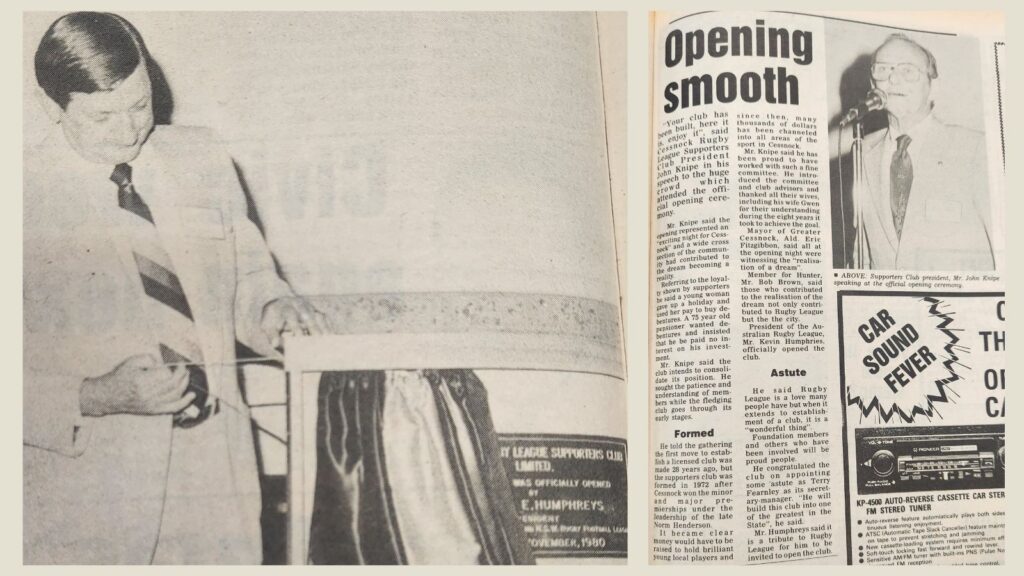
Left, Australian Rugby League president Kevin Humphreys and right, club president John Knipe at the official opening of Cessnock Rugby League Supporters Club on November 8, 1980. Picture: The Advertiser
NSW coach Terry Fearnley was appointed the inaugural club manager after coming from coaching stints with Cronulla and the Eels. However, Fearnley’s time at Cessnock was short-lived; he returned to Sydney just six weeks later. John Knipe took on the secretary-manager’s position on a ‘temporary’ basis (remaining in the role for 18 years until his retirement in 1999), with Boy Bradstreet taking over as club president.
The club has undergone many changes over the past 46 years, including:
- Expansion of the building in 1987
- A major refurbishment in 1991, which included an ‘ultra-modern’ TAB lounge, bistro and restaurant, hair salon and a bottle shop
- The addition of an outdoor terrace in 2007, when smoking was banned indoors at all NSW clubs and pubs
- A revamped bistro and dining area in 2013
- An extensive renovation in 2018, including a new function centre, main bar, sports bar and TAB area, courtyard and administration offices
- And its biggest project yet – the redevelopment that will double the size of the club and is set to open in mid-2026
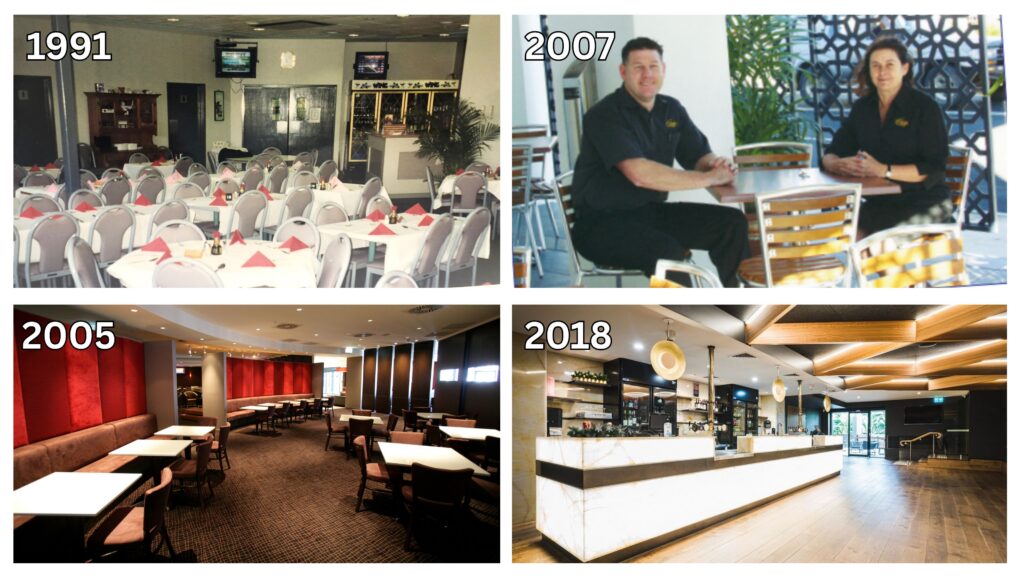
Renovation projects over the years
The company has also expanded over the years, opening Wine Country Motor Inn in 2005, and amalgamating with Paxton Bowling Club in 2016 and Cessnock Ex-Services Club (which became known as Vincent St Kitchen + Bar) in 2018. The company has been known as Cessnock Hospitality Group Ltd. since 2019. Vincent St Kitchen + Bar closed in December 2025, with the restaurant to be relocated and rebranded as part of the Leagues Club redevelopment.
The 2026 redevelopment is not only the most significant project the club has ever undertaken; it is the biggest construction project in the Cessnock CBD since the Big W complex, which opened on the former Cessnock Sportsground site (opposite Cessnock Leagues Club) on Darwin Street 21 years earlier.
The redevelopment will double the club’s seating capacity to 1400, with the addition of a new restaurant, expanded bistro, café and bars, and 1700m2 of outdoor space including landscaped gardens, alfresco dining areas, a new courtyard, a children’s playground, and an outdoor stage for live music and entertainment. The aim of the project is to position Cessnock Leagues Club as a modern, vibrant destination for socialising that meets the needs of a growing community for many years to come.
Sources:
- John Knipe – Cessnock Rugby League Football Club History
- Phil Baird – The Goanna Legend (2011)
- The Advertiser
- The Cessnock Eagle
- The Eagle Weekender
- The Newcastle Morning Herald
– Compiled by Krystal Sellars (Community Engagement Manager, Cessnock Hospitality Group), with thanks to Kimberly O’Sullivan (Local Studies Librarian, Cessnock City Library)